
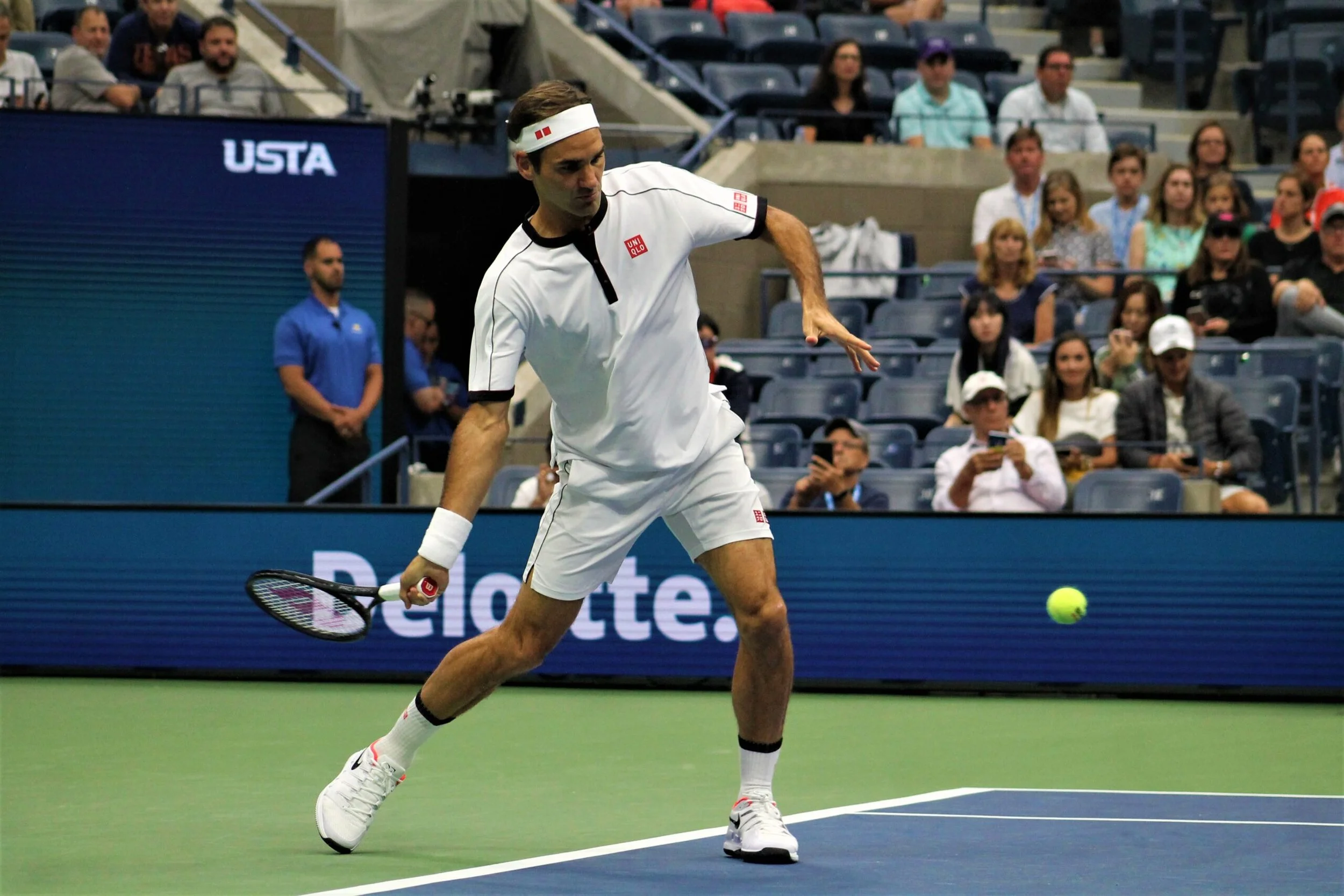
You don't need to manufacture topspin or manipulate your racket to control the ball. Start with the right objectives, develop the right movement, and let the game guide your progress.
First, Solve the First Two Problems
In the first article, we established that the net is the biggest obstacle in tennis. Before we worry about pace, spin, or placement, we have to get the ball over the net and into the court.
That gives us our first objective: lift the ball.
Our second objective is to swing toward the target. The court is long and narrow, so we need a swing that helps us send the ball in the right direction.
These two objectives provide the foundation for everything that follows.
To accomplish them, we get our body down below the incoming ball, position the racket below the ball, and use our legs and core to drive the movement forward and upward through contact. The arm stays connected, while the hand and wrist remain relaxed rather than trying to manufacture the stroke independently.
When we focus on these fundamentals, we give ourselves a reliable way to get the ball over the net without overhitting.
And that's where the next stage of development begins.
Don't Rush the Progression
If you're a beginning player, your job isn't to generate topspin or hit the ball deep into the court. Your job is to learn to lift the ball over the net consistently while swinging toward your target.
That may mean hitting the ball more softly at first. There's nothing wrong with that.
The temptation is to use the arm, hand, and wrist to force the ball where we want it to go. But when we try to manufacture the shot with those smaller parts of the body, we can lose the connected movement that makes the swing work.
Instead, learn to get into position, use your legs, and turn your core through the ball. Keep the arm connected and allow the racket to respond to the movement.
Don't rush to hit harder. First, develop a swing that accomplishes the first two objectives consistently.
The Next Objective: Get the Ball Deeper
Once you can lift the ball over the net consistently, the next objective is to get it beyond the service line and deeper into the court.
This requires us to understand something important about the flight of the ball.
We need enough clearance over the net to give ourselves a margin for error, but we also need the ball to come down inside the baseline. If we try to solve this problem simply by hitting the ball harder or changing our swing to force it down, we're likely to create new problems.
The better approach is to continue developing the same fundamentals.
Get below the ball. Lift through it with your legs and core. Swing toward your target. Give the ball enough height to clear the net comfortably.
As you repeat this movement, you'll begin to develop a better feel for the ball's trajectory and depth. What initially feels like simply getting the ball over the net can gradually become the ability to send it deeper into the court with greater consistency.
Let Topspin Develop
As players develop, they often begin to generate more topspin through these same mechanics.
When the body drives the swing and the racket moves upward through the ball, the conditions for producing topspin are present. With practice, players can develop the timing, coordination, and racket movement that allow them to produce more spin naturally.
Topspin helps the ball dip back toward the court. This is an important part of how more advanced players can hit with greater pace while still keeping the ball inside the baseline.
But notice the progression.
We don't have to begin by telling a player to create topspin. We don't have to ask them to manipulate the wrist or consciously manufacture a particular racket movement.
We begin with the objective: lift the ball over the net.
We develop the movement that helps accomplish it.
And as the player's coordination and feel improve, the ability to shape the ball's flight can develop along the way.
A beginning player and an advanced player are working toward the same fundamental objectives. The difference is in their ability to execute them consistently and the level of pace and spin they can produce.
The advanced player has developed those skills through experience and repetition. The beginning player is on the same path.
A Simple Way to Experience This
Here's a drill I like to use with players.
The goal is to try to hit the ball beyond the baseline—but without overhitting.
Use your legs and core to drive the swing. Keep your arm connected and your hand and wrist relaxed. Focus on the movement rather than trying to force the ball with your arm.
You may find that it's surprisingly difficult to hit the ball long when you're using your body effectively and allowing the racket to respond naturally.
The drill helps challenge the idea that we need to hold back, guide the ball, or manipulate the racket to keep it in the court. It gives players an opportunity to experience how much freedom they can have in their swing while maintaining a connected movement.
The goal isn't to hit every ball beyond the baseline. It's to discover that a good, body-driven swing gives us room to develop more pace without immediately losing control.
Trust the Process
Controlling depth isn't simply a matter of learning another technique. It's part of a progression.
First, learn to lift the ball over the net. Then, learn to swing toward the target. As those fundamentals become more consistent, work toward getting the ball beyond the service line and deeper into the court.
Continue to develop the movement. Allow your feel for the ball to improve. Let the ability to shape the ball's flight develop through repetition.
Eventually, you can produce more topspin and more pace while keeping the ball inside the baseline. But you don't have to force your way there.
Understand the game. Focus on what you're trying to accomplish. Let the technique follow.
